 edpriola
 By Ed Priola
On May 20, 2024, I testified before the Alamance County Board of Commissioners. I highlighted the following changes at ABSS since the 2014/2015 school year (which marked Superintendent Harrison’s first tenure at ABSS):
- Student enrollment dropped 2.4%
- The number of teachers dropped 4.2%
- The number of administrators increased 9.8%
- The number of other professionals (including school psychologists, social workers, and counselors), increased 12.3%.
Source: North Carolina Public Schools Statistical Profile
I urged the Commissioners to cut the administrative bloat in ABSS and reallocate funding from the swollen ranks of other professionals to the shrinking ranks of teachers. My point was that those other professionals appear to focus on political indoctrination—the bigotry of diversity, equity, and inclusion (DEI)—whereas ABSS should focus on education.
The problem with DEI is its focus on equity, which does not mean equal opportunity, but equal outcomes. For example, the School Social Work Association of America defines equity as “the proportional distribution of desirable outcomes across groups. Sometimes confused with equality, equity refers to outcomes while equality connotes equal treatment.” Ensuring everyone gets the same result is a Marxist concept that does not belong in a constitutional republic. And it certainly does not belong in ABSS schools.
Since my testimony, some have claimed there was no evidence of political indoctrination in ABSS schools and advised me to “spend a day, or preferably more time, in an ABSS school.” The fact is that I did “spend a day” in ABSS. I spent weeks in ABSS schools during the 2022/2023 school year as a substitute teacher in all the high schools and several middle schools. I have seen evidence of political indoctrination in multiple schools (I even testified to the ABSS Board of Education about a particularly egregious case at Graham High School). But don’t take my word for it. Let’s review the evidence.
Part I. Is there evidence that ABSS professionals aim to indoctrinate students?
To answer this question, consider the explicit goals and objectives of three different associations of school professionals in North Carolina and their parent organizations: the North Carolina School Social Workers Association (NCSSWA), the North Carolina School Counselor Association (NCSCA), and the North Carolina School Psychology Association (NCSPA).
1. The North Carolina School Social Workers Association (NCSSWA) is the local affiliate of the School Social Work Association of America (SSWAA).
One of the explicit values of SSWAA is:
“Social Justice: School Social Workers advocate and affect policy on behalf of children and families; champion equitable resources for students, families, schools, and communities; and engage in activism in communities to give voice to marginalized populations.”
In furtherance of this value, SSWAA provides a suite of Racial Equity & Social Justice Resources. One of the resources is a “Solidarity Statement with Black Lives Matter” that was specifically endorsed by the North Carolina affiliate. Here is what NCSSWA endorsed:
“As social workers, it is incumbent that we stay informed and engaged in issues of injustice, racism, oppression and violations of human rights that occur all around us. Our professional ethics not only demands competence in areas of diversity and cultural issues but that we “challenge social injustice,” and as such we must be in solidarity with movements such as Black Lives Matter. In doing so, it is not enough to “not be racist,” rather we must be anti-racist and anti-oppressive in our actions. In doing so, we must work to address institutional and structural racism and actively disrupt these systems. State sanctioned violence against Black, Brown, and Indigenous communities is pervasive in the U.S. and we must take action. This means taking action in our personal lives, with our families, in our work, and in our communities. This means taking action as a school by equipping ourselves as faculty, school social workers, and staff to address institutional and structural racism, and the trauma that follows. Our mission as school social workers should be to dismantle white supremacy in our profession and in our schools. When we seek to dismantle systemic racism and oppression created by white supremacy, then and only then are we able to fully embrace and value the diversity in our communities.
As school social workers, we must all step into the discomfort of this conversation as this impacts every one of us when we serve children and teenagers in the schools. If we serve Black youth and other youth of color, we must be willing to assess where we are in our own journey of anti-racism. If we work with white youth, we are equally responsible for breaking the legacy of white supremacy and model for white youth what anti-racism looks like. We need to assess our own spheres of influence and our skill sets, thinking about how we can use our strengths, develop new skills, and be willing to be courageous and take risks in order to enact anti-racist and anti-oppressive practices. Here are some resources to begin these conversations and most importantly, to take action.”
Another Racial Equity & Social Justice Resource includes a Glossary of Terms that defines the following:
“Equity: The proportional distribution of desirable outcomes across groups. Sometimes confused with equality, equity refers to outcomes while equality connotes equal treatment. More directly, equity is when an individual’s race, gender, socio-economic status, sexual orientation, etc. do not determine their educational, economic, social, or political opportunities. […]
Social Justice: is the belief that all people should have equal rights and opportunities. How these rights and opportunities are made accessible and equal may not look or be the same for everyone. The differences in how equality is achieved for everyone is equity at work. […]
Anti-Racism: is the active process of identifying, challenging, and confronting racism. This active process requires confronting systems, organizational structures, policies, practices, behaviors, and attitudes. This active process should seek to redistribute power in an effort to foster equitable outcomes.”
The NCSSWA website includes a section titled “Advocacy.” On that page, visitors are directed to the North Carolina chapter of the National Association of Social Workers (NASW-NC). The NASW-NC website provides “Resources Related to Racism and Racial Equity.” One of those resources is titled “Social Workers Cannot Be Silent: Statement & Call to Action Against Racism & Race-Based Violence” and contains the following excerpts:
“We chose social work instead of another helping profession because of our professional value of social justice. Racial justice should be at the heart of social work practice. Racism is America’s defining social problem. By not acknowledging and addressing this, social workers are ignoring their ethical obligation. […]
Because the United States is rooted in a culture of white supremacy, this means that through systemic exploitation and oppression of non-white people, our society often reinforces and prioritizes the wealth, power, and privilege of white people. This system is supported and perpetuated through culture, beliefs, ideas, policies, laws, and institutions that make these unearned and unfair advantages appear rational and ethical.
We must acknowledge that the social work profession is over 70% white. This means that not only do we as a profession function in a system of white supremacy, we also, largely and collectively, benefit from white privilege.
What should social workers be doing to combat institutional racism and white supremacy?
First, individual social workers have the responsibility to recognize that structural racism plays out in their personal and professional lives. Then we must use that awareness to eradicate its influence in all aspects of social work practice, inclusive of direct practice, community organizing, supervision, consultation, administration, advocacy, social and political action, policy development and implementation, education, and research and evaluation. Silence and inaction is not an option.”
2. The North Carolina School Counselor Association (NCSCA) is the local affiliate of the American School Counselor Association (ASCA).
The NCSCA bylaws specifically state:
“ARTICLE I, SECTION 2. The mission of the North Carolina School Counselor Association is to promote excellence for school counselors and the communities they serve through advocacy, leadership, professional development, and evidence-based best practices which promote equity and access for all. […]
VI-2g. NCSCA promotes awareness of diversity, equity, and inclusion throughout NCSCA’s committees and other work and explores ways to highlight DEI awareness in school counseling.”
On its website, NCSCA provides a link to the “ASCA Ethical Standards for School Counselors,” a document that specifies:
“These standards are the ethical responsibility of all school counseling professionals. […]
School counselors: […]
h. Actively respond to incidents of bias or hate, demonstrating a commitment to equity and promoting a safe, inclusive school community.
h. Actively advocate for systemic and other changes needed for equitable participation and outcomes in educational programs when disproportionality exists regarding enrollment in such programs by race, gender identity, gender expression, sexual orientation, language, immigration status, juvenile justice/court involvement, housing, socioeconomic status, ability, foster care, transportation, special education, mental health and/or any other exceptionality or special need.
o. Use school and community resources to promote equity and access for all students.”
On its website, ASCA offers “resources to assist in school counselors’ work in addressing racism and bias at school and in communities.” One of those resources is titled “All Students Need Anti-Racism Education.” Excerpts are included below:
“Looking at anti-Blackness or inequities brought about by systems rooted in white supremacy and racism is something all students should be doing. While more institutions, including primarily or historically white ones, are committing to this work, white teachers with primarily white students can feel hesitant to discuss these issues since they may not feel it affects them. This idea is a fundamental misunderstanding of what anti-racist work actually is.
Anti-racist work means acknowledging that racist beliefs and structures are pervasive in all aspects of our lives—from education to housing to climate change—and then actively doing work to tear down those beliefs and structures. Those beliefs and structures don’t just exist in primarily white/and or privileged institutions—they thrive there. […]
Anti-racist work cannot be done on an individual or classroom level. Administrators, faculty and staff at primarily white or otherwise privileged institutions must question how this has affected their school, students and community. […]
This means we educators have important questions to ask ourselves: Will I work to be anti-racist? Or will I continue thoughtlessly breathing in what Dr. Beverly Daniel Tatum calls the “smog of racism” and allowing that to affect my classroom, school and conduct in our larger world? We must actively take a stand against racism with all our students if we want to truly fight its systemic grasp on society.”
3. The North Carolina School Psychology Association (NCSPA) is the local affiliate of the National Association of School Psychologists (NASP).
Let’s examine one of the explicit goals of NASP:
“Advancing social justice is a strategic goal for NASP and an ethical principle for school psychologists who serve on the frontlines of advocacy for ALL children. […] School psychologists and other educators can proactively help students and staff in the following ways.
- Recognize and understand the truth about racism and White privilege, and examine our own perspectives and implicit and explicit biases that contribute to perpetuating these systemic problems. […]
- Advocate for and engage in frank discussions about racism and privilege, and provide students and staff tools to combat it. […]
- Ensure that, if law enforcement is present in schools, officers are carefully selected and trained, are not involved in routine discipline, and are evaluated regularly for behaving in ways consistent with training provided by the National Association of School Resource Officers.”
Looking specifically at North Carolina, the NCSPA has a standing Equity Committee described as follows:
“The Equity Committee exists to support the NCSPA Executive Board and the Association with using a racial equity lens to examine NCSPA’s current structures and framework, to provide suggestions to the NCSPA Executive Board to create a more equitable framework of practice, and to support the Association with crafting and implementing priorities put into place. The Equity Committee supports the Association with action-oriented work, critical reflection and analysis, and implementation of the Commitment to Equity. The Equity Committee was born out of the Racial Equity Ad Hoc Committee, which was formed in 2021. The Ad Hoc Committee examined NCSPA’s structures and framework (bylaws, Operations Handbook, committee artifacts, culture and climate) and provided a list of recommendations to the NCSPA Executive Board to improve racial equity.”
The NCSPA organizes conferences and offers specialized training. For example, the 2024 NCSPA Fall Conference had the following “Conference Goals”:
“School psychologists work to ensure the protection of the educational rights, opportunities, and well-being of all children, especially those whose voices have been muted, identities obscured, or needs ignored. Social justice requires promoting non-discriminatory practices and the empowerment of families and communities. School psychologists enact social justice through culturally-responsive professional practice and advocacy to create schools, communities, and systems that ensure equity and fairness for all children and youth (Adopted by the NASP Board of Directors, April 2017).”
The 2023 NCSPA Fall Conference was titled “Leadership for Equity and Improved Outcomes.” One of the educational sessions at this conference was titled “Harnessing the Power of Grassroots Advocacy to Advance Equity.” Excerpts from the session’s description are included below:
“School psychologists have a responsibility, and ethical obligation, to engage in both professional and legislative advocacy to improve policy and practice. This session will provide participants with an overview of the current policy landscape at the national and state level, and describe how school psychologists can use their individual and collective voice to advance equity in opportunity and outcomes for all students.”
Similarly, the 2022 NCSPA Fall Conference provided an educational session titled “The Ethics of Critical Race Theory: Addressing Equity in Schools and the Impact on Families.” Excerpts from the session’s description are included below:
“The current crises of racism and a pandemic, among other issues, faced by families with school aged children demand that school social workers, counselors, school personnel, and community providers serve as essential workers ready to pivot from virtual to in-person learning. The weight of addressing barriers to support students in being academically successful while navigating two pandemics can be overwhelming and discouraging. School psychologists, social workers, counselors, and other school staff provide numerous services that include direct engagement with children and families, advocacy, consultation, school wide planning and crisis intervention. This “new normal” requires that everyone be equipped with renewed strategies to lead antiracism and social justice efforts within school and community settings. This workshop will describe Critical Race Theory and explore its application in ethical approaches to equity in school settings. The presenters will facilitate an interactive and engaging workshop designed to provide a space to discuss the ethical problems confronting school psychologists, social workers, counselors, and other school staff and to formulate strategies for 21st century solutions.
This session meets criteria for continuing education hours in the areas of ethical practice and/or the legal regulation of school psychology and equity, diversity, inclusion, and social justice.”
It is rational to assume that ABSS professionals who are dues-paying members of (and recipients of professional development from) these organizations likely focus on achieving their equity and social justice objectives. So, the answer is yes, there is ample evidence that ABSS professionals aim to indoctrinate students. Moreover, ABSS’s core values specifically include equity (see the image below and the most recent ABSS Strategic Plan).
Part II. What’s the problem with promoting DEI in ABSS schools?
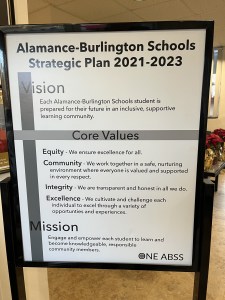 The concepts of diversity, equity, and inclusion sound good. So, what’s the problem with promoting DEI in ABSS schools? DEI implements a divisive ideology that attributes differences between groups to systemic injustice and discrimination. According to DEI advocates, the solution to that systemic discrimination is treating people as members of groups, rather than individuals, and focusing on equity. Unfortunately, equity in DEI does not mean equal opportunity, as highlighted in the SSWAA definition above. Rather, it means equal outcomes (i.e., making sure every person gets the same result), a distinctly Marxist idea.
Read more about DEI from various sources (coming at the topic from different perspectives):
- What do we really mean by ‘diversity, equity and inclusion’?
- The Diversity Problem on Campus
- The equity wars
- Map: See which states have introduced or passed anti-DEI bills
- Kamala Harris’ ‘equality of outcome’ video slammed as communism pitch